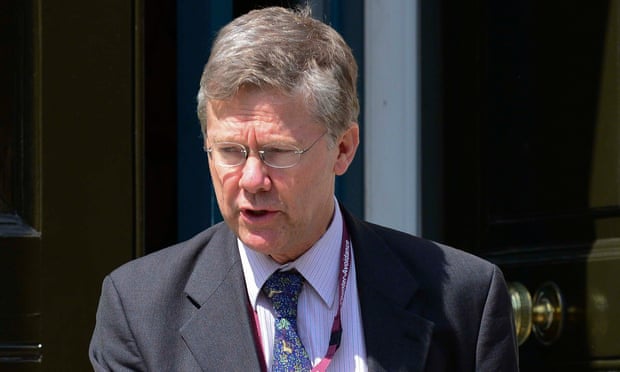
Edward Troup is former partner at legal practice Simmons & Simmons whose clients included Panama-registered fund created by prime minister’s father
The boss of Revenue & Customs (HMRC), the government department overseeing a £10m inquiry into the Panama Papers, was a partner at a top City law firm that acted for Blairmore Holdings and other offshore companies named in the leak.
Edward Troup, executive chair of HMRC since April, is a former partner at Simmons & Simmons, whose clients have included the Panama-registered fund created by David Cameron’s father, Ian.
The law firm’s name appears on dozens of emails and documents in the Panama Papers in connection with a number of companies registered with Mossack Fonseca, the offshore agent at the centre of the scandal, although HMRC said Troup had not personally dealt with the firm. Some correspondence dates back to 2003, when Troup was still a partner. The first emails to Mossack Fonseca regarding Blairmore date from 2005. It is understood that Simmons & Simmons was advising Blairmore from 2001.
Troup, who described taxation as “legalised extortion” in a 1999 newspaper article, built a career advising corporations on how to reduce their tax bills before leaving Simmons & Simmons to join the civil service in 2004.
Simmons & Simmons is reported to be among a number of legal practices that received letters last week from the legal watchdog asking them to inspect their files for connections to Mossack Fonseca. The Solicitors Regulation Authority is understood to have written to Simmons & Simmons asking it to carry out a review. Troup worked at the firm from 1997 until 2004, when he left to join the Treasury as head of corporate tax policy. He joined HMRC in 2012 to oversee large corporate tax settlements.
While working in the City, Troup led the opposition to reforms put forward by Gordon Brown to curb corporate tax avoidance in 1999, putting out a press release headed: “City lawyers call on government to withdraw proposals to tackle tax avoidance.” He criticised the proposed laws for giving “wide-reaching” powers to the Inland Revenue.
The leaked Panama Papers appear to show Simmons & Simmons offices in London and Hong Kong were registered as clients or intermediaries with Mossack Fonseca. This means they were able to request certificates or new incorporations on behalf of the ultimate owners of companies. Usually, Mossack Fonseca did not deal with company owners directly, but preferred to handle business through intermediaries such as lawyers and accountants.
Simmons & Simmons did not respond to a request for comment.

COVENTRY MESSAGE BOARD
Website is subject to occasional intereference from an unknown source...
HMRC chief was partner at law firm that acted for Cameron offshore fund
2 posts
• Page 1 of 1
HMRC chief was partner at law firm that acted for Cameron offshore fund
 by dutchman » Mon Apr 11, 2016 12:45 am

-

dutchman - Site Admin
- Posts: 58941
- Joined: Fri Oct 23, 2009 12:24 am
- Location: Spon End
Re: HMRC chief was partner at law firm that acted for Cameron offshore fund
by rebbonk » Mon Apr 11, 2016 9:13 am
Simmons & Simmons did not respond to a request for comment.

For years this cozy little relationship between the big accountancy firms, HMRC and government has been going on. The government enlist (and pay for) the help of the accountancy firms in drafting tax laws. Those very same accountancy companies then collect from clients trying to avoid the very laws that they've just helped draft! - Great double-sided scheme if you can get on it!
Of course it'll fit; you just need a bigger hammer.
-

rebbonk - Posts: 73552
- Joined: Thu Nov 12, 2009 6:01 am
2 posts
• Page 1 of 1
Who is online
Users browsing this forum: No registered users and 42 guests
-
- Ads
Powered by phpBB® Forum Software © phpBB Group
