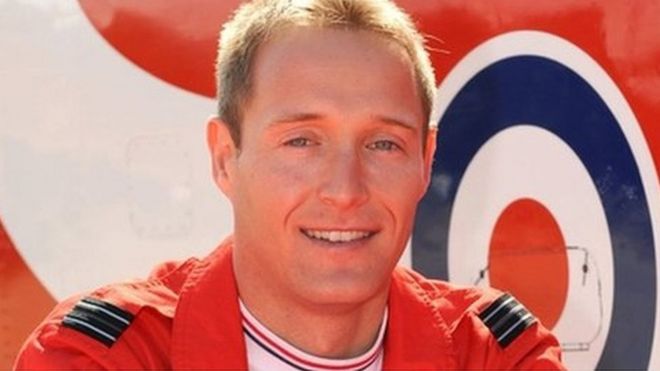
Red Arrows pilot Sean Cunningham inquest: Seat mechanism 'useless' Flt Lt Sean Cunningham's father said his son's death was "preventable"
A coroner has described part of an ejection seat that threw a Red Arrows pilot to his death as "entirely useless".
Flt Lt Sean Cunningham was killed at RAF Scampton, Lincolnshire, after being accidentally ejected from his Hawk T1.
The inquest has heard that he was ejected because of a problem with the ejection seat firing handle.
The coroner recorded a narrative conclusion following the three-week inquest.
The 35-year-old pilot, who was born in South Africa and grew up in Coventry, died on 8 November 2011.
The inquest has heard that the ejection seat firing handle had been left in an unsafe position which meant it could accidentally activate the seat.
Testing of the Mk.10 Martin-Baker seat showed that the safety pin could be inserted even when the seat was in this unsafe position, giving the impression the seat was safe.
Coroner Stuart Fisher said the safety pin mechanism was "entirely useless".
Seven RAF personnel had 19 opportunities to check the ejection seat firing handle, but did not notice it was in the unsafe position.
Mr Fisher said the "repeated failure to notice this" could only be due to the check "not being done at all or not done sufficiently carefully by each individual".
Flt Lt Cunningham's parachute should have saved his life, but the main chute failed to deploy because a nut and bolt had been fastened too tightly, the inquest heard.
Mr Fisher said none of the engineers who worked on the parachute mechanism can be criticised.
Martin-Baker knew the parachute mechanism could jam if the nut and bolt were too tight as early as January 1990, the inquest was told.
The manufacturer warned some air forces but did not warn the MoD.
Mr Fisher said: "There was a very serious failure of communication by Martin-Baker in my view.
"It is unexplained by the evidence. It seems there is no logic to warn and inform some but not others."
Lincolnshire Police conducted a criminal investigation into the death, and the Crown Prosecution Service (CPS) considered manslaughter charges against the Ministry of Defence, Martin-Baker and three unnamed individuals.
The CPS concluded that no manslaughter charges should be brought, due to "insufficient evidence".
However, the Health and Safety Executive (HSE) could still prosecute Martin-Baker and/or the MoD, and will consider whether to do so now the inquest has concluded.
Flt Lt Cunningham's parents agreed an undisclosed settlement with the MoD in December, after the MoD admitted liability for the incident.
Martin-Baker issued a statement extending "sincere condolences" to Flt Lt Cunningham's family and friends.
"On this occasion, uniquely in the entire history of Martin-Baker ejection seats using this particular feature, it [the parachute] failed due to a shackle bolt being too tight.
"In light of this incident, lessons have been learned and we have taken steps to alert all our customers worldwide who still use this type of seat, of the risk of over tightening the shackle."
Flt Lt Cunningham took Night Nurse medication the night before the accident, but Mr Fisher was satisfied this did not impair his abilities.
Speaking after the inquest, his father Jim Cunningham said: "We welcome the conclusion of the coroner which confirmed what we knew all along, which is that Sean was blameless and his tragic death was preventable,
"We therefore welcome the coroner's recommendations which we hope and pray will ensure no family such as ours has to endure such a pointless and avoidable death."

 Posted: Tue Nov 08, 2011 6:50 pm